Who Was Henry Flagler?
Henry Morrison Flagler co-founded Standard Oil with John D. Rockefeller in 1868. By the mid-1880s, his attention had shifted south. Florida's winters were too good to resist — and he had the money to reshape them.
In 1885, Flagler began extending the Florida East Coast Railway south from Jacksonville, building it as he went. He arrived in St. Augustine and saw something that most of his contemporaries missed: a Spanish colonial city that represented the oldest continuously settled European settlement in the United States. Perfect for a luxury hotel.
By 1888, Flagler had commissioned three hotels, a railroad station, and two churches. He hadn't just built a hotel company. He'd built a destination.
The Three Hotels
Hotel Ponce de León (1888)
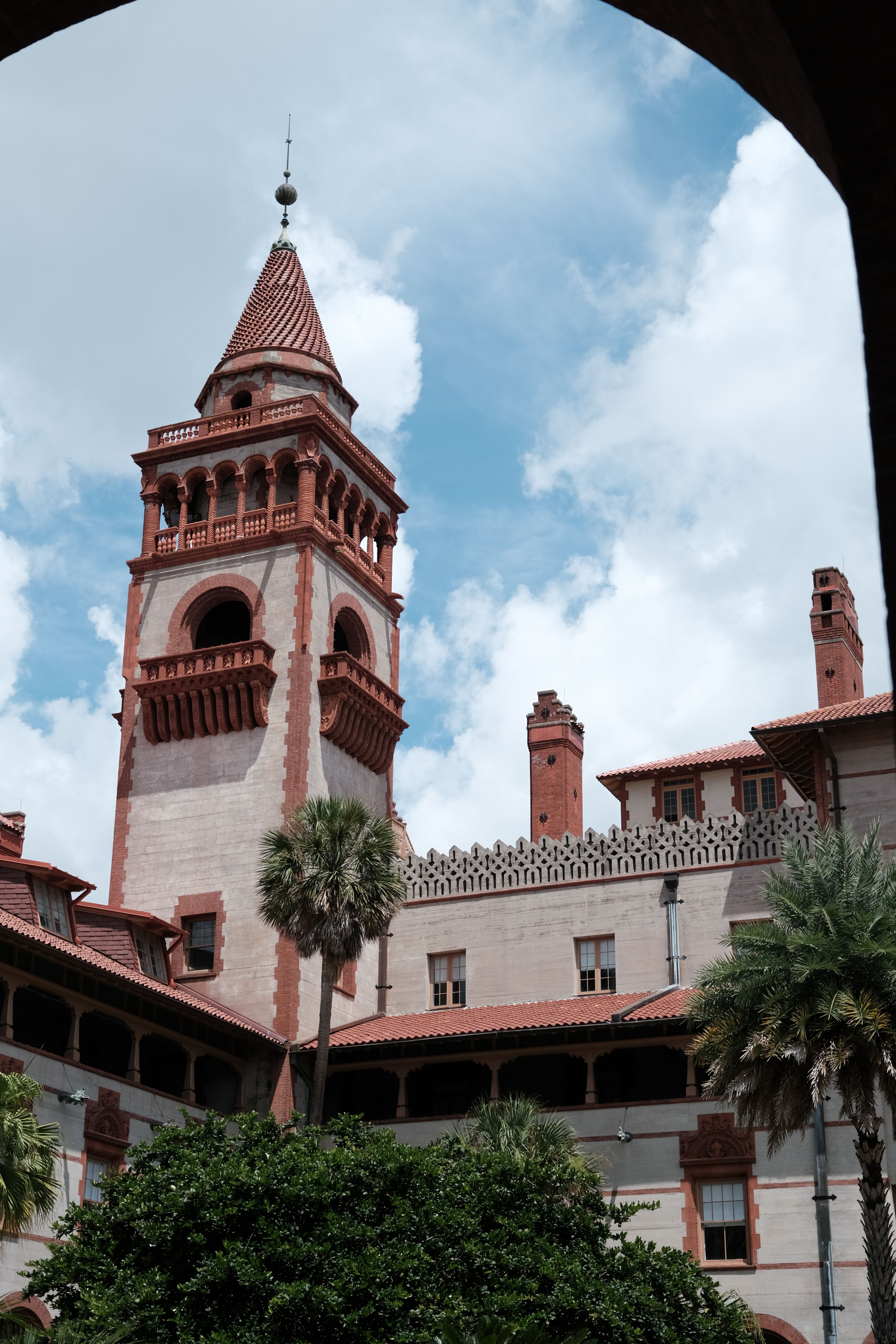
Designed by Carrère and Hastings — two architects in their mid-twenties who'd trained in Paris at the École des Beaux-Arts. The Ponce de León was poured entirely in concrete, experimental in 1888 and still standing today as Flagler College. The rotunda is four stories under an original skylight, the murals from Paris, the iron gates the same ones Flagler hung in 1888. Free to enter during school hours.
Hotel Alcazar (1888)
Same architects, same year, across the street. The world's largest indoor pool — 40 by 80 feet, heated, lit by a massive skylight. Russian and Turkish baths. A three-story ballroom that held 500 dancers. The health facilities were so good that guests at the Ponce de León crossed the street to use them. Today it's the Lightner Museum. (See our full deep-dive on Hotel Alcazar and how it became the Lightner Museum.)
Hotel Cordova (1890)
Smaller than its siblings, built in Spanish Colonial Revival style. Corner of St. George and Cordova Streets. Now a mix of retail and residential — the name survives, the use has changed.
The Half-Day Walking Route
Start at The Rambler's address, work outward, return. Five stops, a few hours, no vehicle required.
Stop 1 — Lightner Museum Courtyard (0 min) — 75 King St. Stand where you're standing. The courtyard is the same stone, the same arched walls. Turn around — that's The Rambler's entrance. This is where the walk starts and where it ends.
Stop 2 — Hotel Ponce de León / Flagler College (30 min walk) — 74 King St. Iron gates on the corners are original. Enter the rotunda and look up. Four stories, original skylight, murals from Paris. If it's a weekday during school hours, you're in.
Stop 3 — Railyard & St. Augustine Distillery (20 min walk) — 117 S. Charlotte St. The old FEC railyard is now a quiet food corridor. St. Augustine Distillery runs small-batch rum and whiskey from a 1902 ice plant building. Good coffee stop before the afternoon stretch.
Stop 4 — Plaza de la Constitución (45 min) — St. Augustine Plaza. Flagler funded the 1887 restoration of this Spanish plaza. The bandstand was built for winter visitors who needed somewhere to go in the evenings. It's still there. Still used.
Stop 5 — St. George Street (15 min walk) — St. George Street pedestrian corridor. The original flagstones are visible in places. Cart ruts worn into the limestone by Spanish traffic. The gates at both ends of the colonial quarter are the same gates.
Stop 6 — Return to The Rambler (30 min) — Suite 120, 75 King St. Back to the courtyard. Coffee's waiting.
Where to Eat and Drink Along the Way
The route has good food at every point. A few specifics:
Breakfast — The Rambler. Espresso, pastries, grab-and-go combos. Opens at 7am. Courtyard seating.
Lunch — Cafe Alcazar. Inside the former Alcazar pool room. Vaulted ceiling, original tile, 80-foot skylight. Lunch daily; reservations recommended October through March.
Late afternoon — St. Augustine Distillery. 117 S. Charlotte St. Small-batch rum and whiskey, well-made, historic building worth seeing. Coffee usually available.
Dinner — Collage (upper end, worth it) or The Railyard (casual, good pasta). Both on Charlotte Street.
Why This Walk Is Still Worth Your Time
St. Augustine gets a tourist-trap reputation, and in places it's earned. This walk isn't one of them. The buildings are real. The courtyard is free to enter. The Ponce de León rotunda is open during school hours. None of it has moved.
What Flagler built here in three years — 1886 to 1888 — was a deliberate act of imagination about what Florida could be. He wasn't wrong. The buildings survived hurricanes, the Depression, decades of change. You can still walk through them on a Tuesday morning and feel what it was designed to feel like.
See the full history of how this building became The Rambler's home — and the Flagler railroad car the brand is named for. Read our origin story.