INSIDE HOTEL ALCAZAR: THE 1888 BUILDING THAT BECAME THE LIGHTNER MUSEUM
The building at 75 King Street opened on Christmas Day 1888 as the Hotel Alcazar. By the following spring, it was already being called the most complete resort facility in the South. It had a three-story ballroom. It had Turkish and Russian baths. It had the world's largest indoor swimming pool — 40 by 80 feet, lit by a massive skylight, filled with water from artesian wells. It had a casino, a library, a barbershop, a bowling alley, and a restaurant that served French cuisine to people who had arrived on Henry Flagler's railroad.
It was open for 44 years. It has been a museum for 78.
The building is worth knowing for both of those lives — the Gilded Age resort and the Victorian collection — and for the thirty-year gap between them, when the Alcazar sat empty on King Street, waiting.
The Commission
Henry Flagler built the Alcazar as a companion to the Hotel Ponce de Leon across the street. He had commissioned the Ponce de Leon first, designed it by Carrere and Hastings, and opened it in 1888 to considerable attention. But the Ponce de Leon was primarily a lodging facility — elegant, impressive, but designed around the guest room and the dining room. The Alcazar was built to be the entertainment complex of the resort.
The architects were the same — John Carrere and Thomas Hastings, both in their mid-twenties at the time, trained at the Ecole des Beaux-Arts in Paris. They would go on to design the New York Public Library, the parts of the National Mall that include the Department of the Interior building, and several major Gilded Age hotels. The Alcazar was their second major commission; the Ponce de Leon was their first.
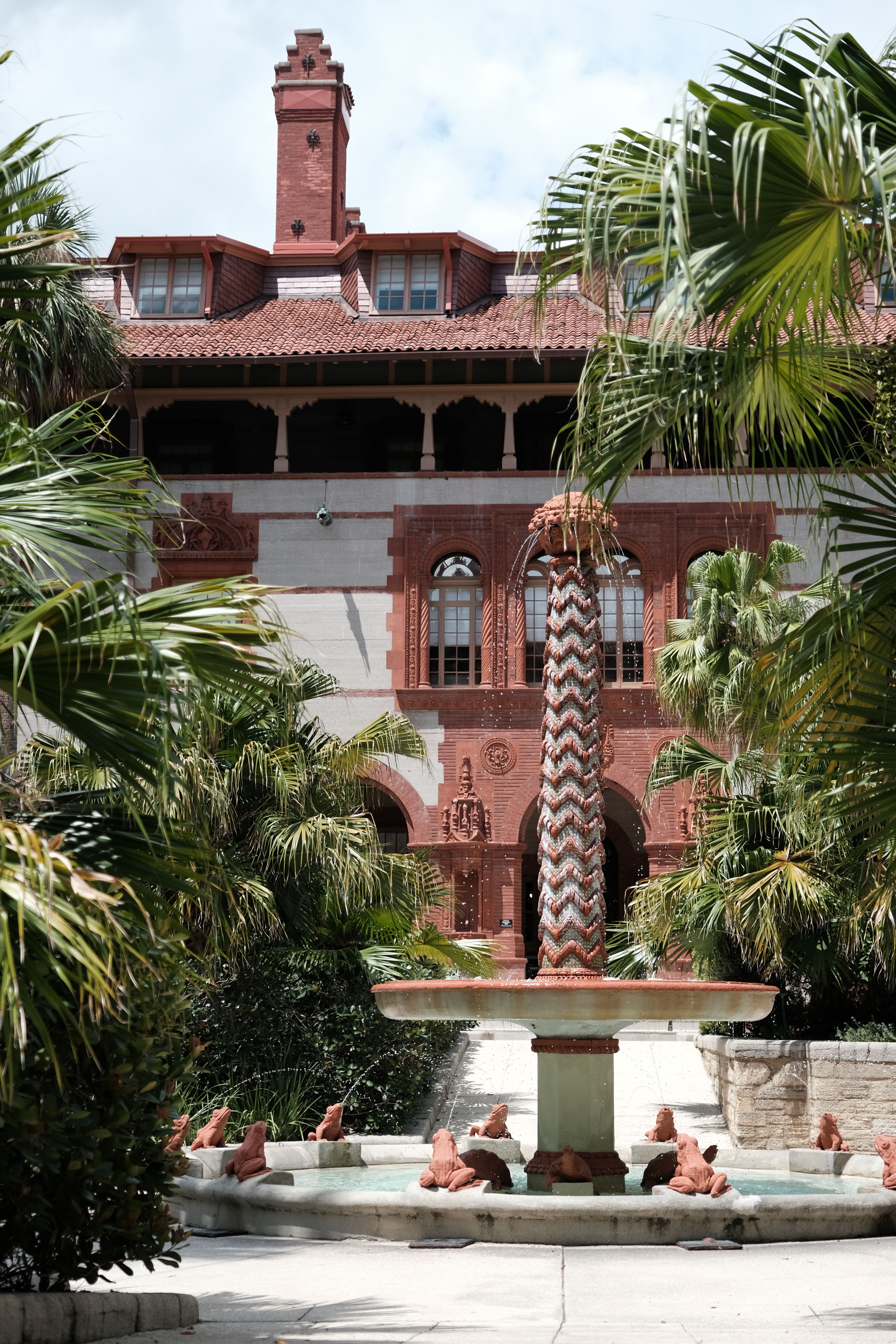
The Spanish Renaissance Revival building was designed to be seen from King Street — its most impressive facade faces the main drag, with an arcade of arches at ground level and a symmetrical five-story elevation above. The courtyard was the interior common ground: two stories, arcaded on both levels, centered on a fountain that has been there since 1888. The original tile floor is still visible in places. The koi are not original.
Carrere and Hastings designed the building to maximize natural light — a concern in a climate where summer heat is a real consideration. The arcade provides shade; the mass of the building provides thermal inertia; the skylights over the major public spaces bring light in from above without exposing the interiors to direct sun. It's a building that was designed intelligently for its climate, not just its aesthetics.
The Interior in 1888
The pool was the centerpiece. At 40 by 80 feet, it was the largest indoor pool in the world — a claim the hotel made explicitly and repeated in every piece of promotional material for the next forty years. The water came from artesian wells, which in 1888 meant clean, cold, mineral-rich water with enough pressure to fill and drain a pool of that size. The skylight above the pool ran the length of the room and lit the water in a way that made it genuinely striking.
The pool was surrounded by a gallery — a corridor on the second floor that looked down into the water. Guests could sit above the pool and watch swimmers below. The effect was theatrical. It was designed to be.
The Turkish and Russian baths occupied the basement level — a series of interconnected rooms with different temperature zones, steam rooms, cold plunges, and heated marble slabs. The health facilities at the Alcazar were considered the most complete in the Southeast. Guests at the Ponce de Leon across the street regularly crossed King Street to use them.
The ballroom was on the third floor, with a sprung floor designed for dancing and a ceiling height that made it feel like a proper room rather than an attic. It held 500 dancers at capacity. The hotel ran balls every week during the season — December through March — when the winter visitors were in residence.
The casino occupied the ground floor arcade — not a gambling facility in the modern sense, but a social space: card tables, afternoon tea, a bar, and a view of the courtyard. It was the kind of space that a Gilded Age resort hotel ran as an amenity for guests who wanted somewhere to be between meals.
The 1930s and the Empty Years
The hotel closed in 1932. The reasons were economic: the Florida land boom had collapsed in 1926, the Depression had arrived, and the Florida East Coast Railway — which had funded the whole project — had gone into receivership in 1931. The Alcazar, like the Ponce de Leon, was no longer sustainable as a luxury hotel.
The Ponce de Leon became a military training facility during World War II. The Alcazar became a city hall — St. Augustine's city commission moved in, and the building served as a civic building for a few years. But the Depression had damaged the structure, the pool had drained and been neglected, and the ballroom had been used for purposes its architects hadn't intended. The building wasn't destroyed, but it wasn't maintained either.
By 1945, the city had moved out. The Alcazar was vacant.
Otto Lightner
Otto Lightner was a publisher from Chicago — he had founded a trade magazine called Hardware Trade and built a business around it. In the 1930s, as his business career wound down, he turned his attention to collecting. He had been collecting Victorian-era decorative arts for decades: mechanical music boxes, antique furniture, cut glass, Victorian jewelry, decorative ceramics. He had a significant collection and no good place to put it.
He came to St. Augustine in 1947 and saw the Alcazar. The building was large enough to display his collection. The city was willing to sell. He bought it for $150,000 — a fraction of its construction cost — and spent the next two years converting it.
The conversion was not a restoration. Lightner was not trying to return the Alcazar to its original appearance. He was installing his collection in a building that was large enough to hold it. The pool room became a dining room — Cafe Alcazar, which is still there. The ballroom became gallery space. The arcade rooms became display areas for his mechanical music collection, his antique furniture, his cut glass.
The museum opened in 1948. Lightner ran it until his death in 1950, when he left the building and the collection to the city in his will.
What Survived
Very little of the original Alcazar interior survived the 1930s and the Lightner conversion intact. The pool is still there — drained, tiled over, now the floor of Cafe Alcazar. The skylight above it is the original. The gallery that looked down into the pool is now part of the restaurant's mezzanine.
The ballroom became gallery space and has been repainted several times. The arcade rooms have been partitioned and reconfigured. The Turkish baths in the basement were sealed — Lightner converted the basement to storage and display areas.
What survived best was the exterior: the five-story facade on King Street, the courtyard arcade, the stone arch bridge over the koi pond, the original tile in some areas of the courtyard floor. The building reads correctly from the street in a way that it doesn't read correctly from the inside. The shell is original; the contents are the Lightner collection.
The Collection Today
The Lightner Museum's collection spans three floors and includes Victorian decorative arts, antique mechanical musical instruments, cut glass, antique toys, and natural history specimens. It's a 19th-century cabinet of curiosities — the kind of collection that someone with means and obsession assembled over a lifetime and then gave to a city.
The most remarkable part of the collection for most visitors is the mechanical music gallery on the third floor. Lightner collected self-playing instruments — player pianos, orchestrions, music boxes — and the museum has a significant collection that it demonstrates twice daily. The instruments are working; the demonstrations are live. If you've never heard a large orchestrion play, it's the kind of experience that doesn't have a modern equivalent.
The cut glass collection is in the ground-floor galleries — American art glass from the late 19th and early 20th centuries, including several Tiffany pieces. The gallery is well-lit and never crowded. You can spend 20 minutes in it and feel like you got something out of it.
The Courtyard and Why It Matters
The courtyard is the part of the Alcazar that most closely resembles its original state. The arcade was designed to be the social center of the hotel — the place where guests gathered between activities, where afternoon events were held, where the fountain provided ambient sound and visual interest.
In 1888, the courtyard held 25,000 guests per season. The hotel's promotional material from the era describes it as the social heart of the resort — a place where guests from the Ponce de Leon and the Alcazar mixed in the evenings, where the winter social season played out in real time.
Today the courtyard is free and open. No ticket required to stand in it. The koi are the current residents; the fountain is the original; the arches are the original stone. Cafe Alcazar's tables are in the courtyard in season. The Rambler's entrance is on the east side of the arcade — Suite 120, with its own door off the courtyard.
The Lightner Building is a building with three lives: Gilded Age resort, empty decades, Victorian museum. The courtyard is where all three overlap. It survived the empty years better than the interior because it was exterior — exposed to weather, but structurally sound. What you're standing in is the same space that held 25,000 guests in the winter of 1889.
Visiting
The Lightner Museum is open 9am–5pm, 363 days a year. Last entry at 4pm. Adults $17, seniors and college students $14. The courtyard is free at all hours — it doesn't require a museum ticket.
Cafe Alcazar is open daily 11am–3pm. Lunch in the former pool room is one of the quieter dining experiences in St. Augustine.
The Rambler is in Suite 120 — the same building, courtyard entrance on the east side. Opens at 7am daily, evenings on weekends.