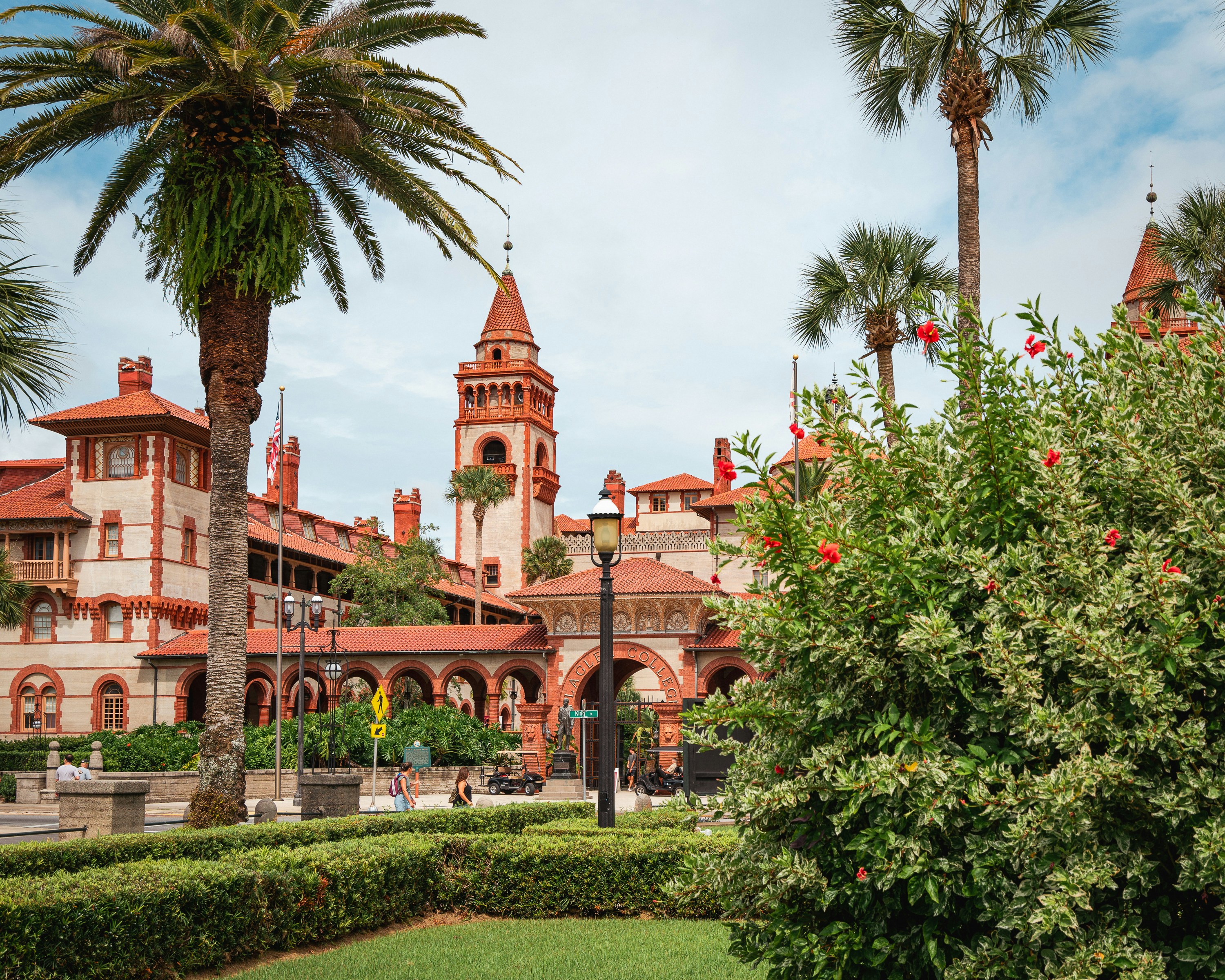
A TIFFTY STAINED GLASS WALKING TOUR OF ST. AUGUSTINE: LIGHTNER, MEMORIAL PRESBYTERIAN, AND FLAGLER COLLEGE
St. Augustine has more Louis Comfort Tiffany stained glass per square mile than anywhere else in the world. Not because the city commissioned it — because Henry Flagler did, in 1888, when he hired Tiffany to design the interior decoration of his new hotel. The commission spread from there. What followed is one of the most concentrated collections of Tiffany's work anywhere, assembled across three buildings within a five-minute walk of each other.
This is not an art-history lecture. It's a walking tour of what survived — what you can go see this week, in the morning, before the day gets long.
The Commission That Explains Everything
In 1888, Henry Flagler hired Louis Comfort Tiffany to decorate the interior of the Hotel Ponce de Leon. Tiffany was thirty-six, still building his reputation, and the Ponce de Leon was his largest commission to date. He was given a budget and a brief: make this the most impressive winter resort hotel in America.
He delivered. The project included 79 windows in the hotel's dining hall alone — the windows that are now in the Flagler College dining hall, visible on the campus tours. But the commission didn't stop at windows. It included murals, light fixtures, decorative glass panels, and what the hotel described in its promotional material as "Tiffany's latest innovations in colored glass."
The Ponce de Leon commission put Tiffany on the map in a different way. The dining hall windows became known nationally. Visitors who had never heard of St. Augustine had heard of the Tiffany windows. The reputation of the building and the reputation of the glasswork reinforced each other for decades.
That relationship — Flagler's money, Tiffany's vision, St. Augustine as the venue — explains the concentration of work here. When the hotel changed use in 1968 and became Flagler College, the windows stayed. When other buildings in town needed glasswork, the standard set by the Ponce de Leon was the reference point.
Stop One: Flagler College — The Dining Hall
The starting point is Flagler College — the former Hotel Ponce de Leon, 74 King Street. Tours run daily at 10am and 2pm ($12 adults, $17 for the full interactive experience). The campus is open to visitors during school hours on weekdays — enter through the main gates on King Street and walk to the rotunda. The dining hall is visible from the rotunda, and the Tiffany windows line the upper walls of the room.
The 79 windows were designed in five styles: floral, landscape, architectural, symbolic, and medallion. They were made in Tiffany's studios in New York, shipped south, and installed in 1888. The subjects draw from Florida — palmettos, magnolias, herons, sunrises over water — but the glasswork technique is pure New York Tiffany studio: opalescent glass, copper-foil construction, layered color that changes in direct light versus diffused light.
In 2020, the college completed a $25 million renovation of the dining hall. The windows were restored and backlit — a system of LED fixtures installed behind each window to bring out the color in the glass. The renovation made a significant difference. The windows read differently at noon than they did before the lighting system. If you've been here before 2020, come back. It's not the same room.
The Flagler Room — also known as the Women's Parlor — is worth seeing for different reasons. Original decorative plaster, original ironwork, original chandeliers. It's been used as a reading room, a reception space, and a display gallery. As of early 2026, it's temporarily closed for renovation through August, but the rest of the building — the rotunda, the dining hall, the hallways — is open.
If you're here for the Tiffany specifically: the dining hall is the destination. Everything else on this walk is context.
Stop Two: Memorial Presbyterian Church
From Flagler College, walk east on Cathedral Place. The Memorial Presbyterian Church is at 32 Cathedral Place — a two-minute walk.
The church was commissioned by Henry Flagler in 1889, designed by Carrere and Hastings (the same architects who designed the Hotel Alcazar), and completed in 1890. Flagler built it partly to entertain the winter visitors who needed somewhere to go on Sunday mornings, and partly as a memorial to his first wife, Mary, who died in 1881.
The church contains a significant Tiffany window collection — not as many as the dining hall, but the subject matter is different. The memorial windows in the front of the church are dedicated to figures in Flagler's world: John D. Rockefeller, Flagler's partners, Flagler family members. The craftsmanship is the same, but the context is more personal.
The church is open to visitors during the day. Services are on Sunday mornings. The sanctuary is small — it holds about 250 — and the windows are visible from the pews in a way they aren't at Flagler College, where you're looking up at the dining hall through a different kind of glass.
There's a smaller collection of Tiffany work in the church's rear chapel: memorial panels and smaller windows in a softer palette. The light in the afternoon makes the rear chapel worth ten minutes of your time.
Stop Three: The Lightner Museum
The third stop is the Lightner Building — 75 King Street, the same building that houses The Rambler in Suite 120. The Lightner Museum holds a smaller but more varied collection of Tiffany work.
The building itself — the former Hotel Alcazar — was not decorated by Tiffany. But Otto Lightner, who bought the building in 1947 and opened it as a museum in 1948, was a serious collector of Victorian-era decorative arts, and his collection includes Tiffany glassware: vases, desk objects, stained glass panels, and lamps. Many of these are displayed in the museum's ground-floor galleries, which are air-conditioned, well-lit, and never as crowded as the Flagler College tour route.
The museum's collection is different in character from the institutional work at Flagler College. The dining hall windows are architectural — part of a building, designed to be seen as a group, in a specific room. The Lightner collection is domestic: objects made for a sitting room, a mantelpiece, a desk. You see them differently. The scale is smaller; the detail is more precise.
For timing: the Lightner Museum opens at 9am and closes at 5pm. The last entry is at 4pm. If you're doing the walk in the morning — which is the right call, because the light is better and the building is cooler — start at Flagler College (10am tour), walk to Memorial Presbyterian (11am), and finish at the Lightner Museum (11:30am). You're done before noon, and you have the rest of the day.
The Walk Itself
The three stops form a rough triangle, all within a five-minute walk of each other. From Flagler College to Memorial Presbyterian: two minutes east on Cathedral Place. From Memorial Presbyterian to the Lightner Museum: two minutes south on Cathedral Place to King Street, then 30 seconds west to the Lightner Building entrance. From the Lightner Museum back to Flagler College: across the courtyard, under the arch, 90 seconds north.
The walk between stops is part of the tour. You're moving through the same streets Flagler built his hotels on — King Street in 1888 was the main commercial corridor of the winter resort, lined with shops and carriage entrances for the Ponce de Leon and Alcazar. The buildings have changed; the street grid hasn't.
The Lightner Museum courtyard — the old Alcazar courtyard — is worth walking through even if you're not going into the museum. The stone arch bridge, the koi pond, the two-story arcade. Original 1888 features. The courtyard is free and open during museum hours. Stand in it for five minutes before you go back to wherever you were going.
What to Know Before You Go
Tickets and timing: Flagler College tours sell out on weekends in season. Buy at flagler.edu or at the door. The 10am tour is the morning move — it clears you for the rest of the morning by noon.
Photography: Allowed in the dining hall. Not allowed in the Flagler Room during renovation. No flash.
Accessibility: Flagler College has steps at the main entrance; a side entrance is available. Call ahead if you have mobility needs. Memorial Presbyterian has a ramp at the front entrance. The Lightner Museum is fully accessible.
Combine with coffee: The Rambler is in the same building as the Lightner Museum. The walk starts or ends there — your call. Suite 120, courtyard entrance.
Why Tiffany, Why Here
Louis Comfort Tiffany worked in New York. His studio produced windows for churches, private residences, and public buildings across the country. The St. Augustine collection exists because of a specific commercial decision: Henry Flagler chose Tiffany for the Ponce de Leon because he wanted the hotel to be the best, and Tiffany was the name that meant best in 1888.
The windows survived the hotel-to-college conversion in 1968. They survived decades of deferred maintenance. They survived the 2020 renovation, which was specifically about preserving them for the next generation. What you're seeing in the dining hall is 136-year-old glasswork that has been maintained, restored, and backlit — not replaced.
That's the thing worth carrying out of this walk. The light in the room changes because the windows are original. Every other version of this experience — every photograph, every description — is filtering something that was made to be seen directly, in a specific building, in St. Augustine, where Flagler put it in 1888 and where it still is.