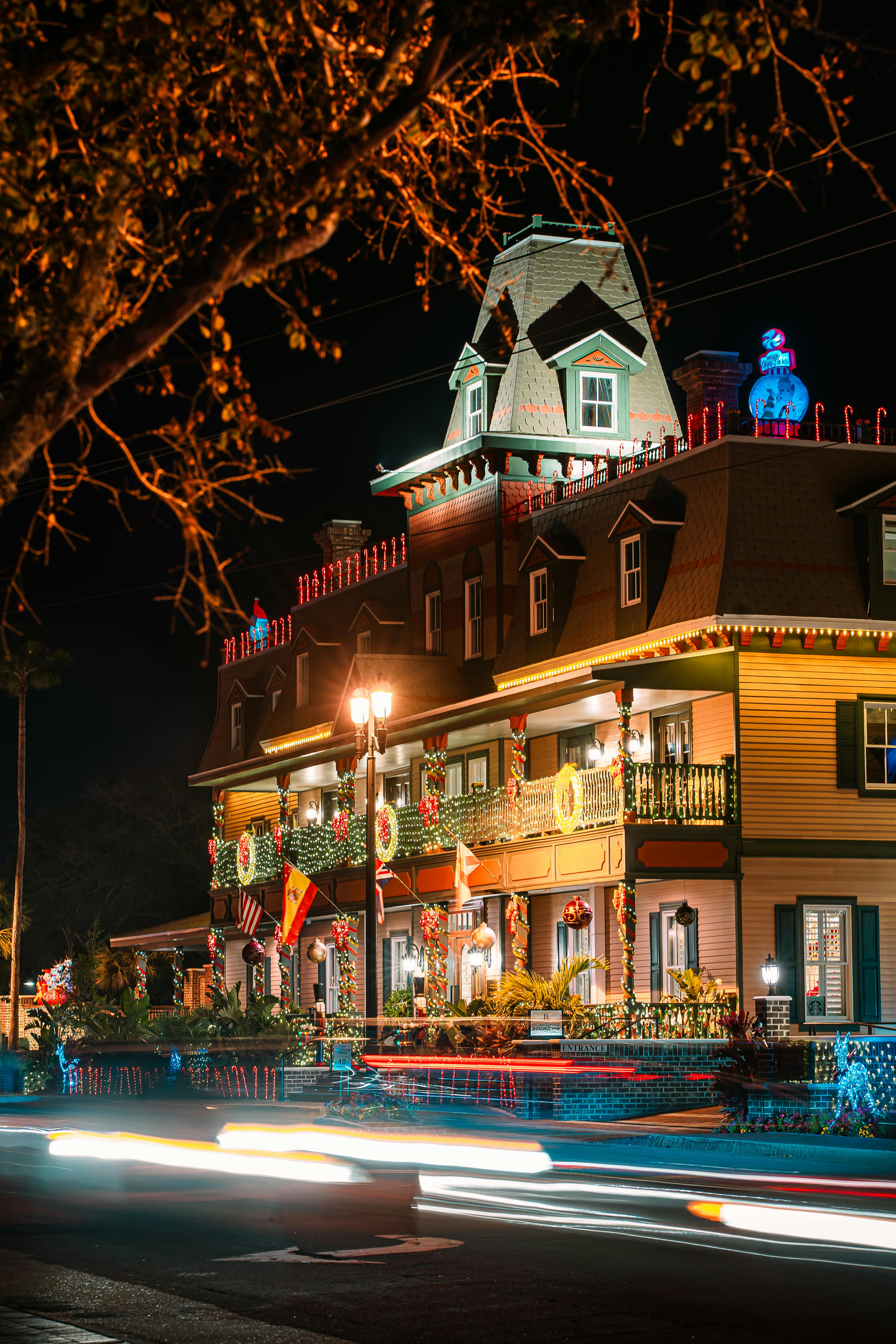
NIGHTS OF LIGHTS VISITOR'S GUIDE: WHERE TO WARM UP, REFUEL, AND RESET IN ST. AUGUSTINE
St. Augustine runs 3 million lights from mid-November to mid-January every year. It has since 1991. The city doesn't do it for the tourists — it started because the local Junior Service League needed a winter event and the city needed a reason for people to come downtown in the slow season. Thirty-four years later, it's been called one of the top holiday light displays in the country by National Geographic, and the season anchors the city's entire winter economy.
The timing is worth noting: in 2026, the city commission voted to shift the start date. Nights of Lights now runs from November 21, 2026, through January 18, 2027. The lights go on at dusk and stay on until 10pm nightly. This matters if you're planning around it — the old November 15 start date is gone.
This is not a comprehensive everything guide. It's a practical one. How to move through it without hating your life, where to warm up when your hands are cold, how to do it with kids or without them, and why The Rambler's courtyard is the best midpoint on the whole route.
What You're Walking Into
Nights of Lights is a self-guided experience. There are no tickets, no wristbands, no official start point. The city wraps the historic district — the colonial quarter inside the old city gates, plus the bayfront — in lights strung along every arch, lamp post, and Spanish moss branch. The effect is not subtle.
The core loop is about 1.5 miles and runs from the Plaza de la Constitucion down St. George Street to the bayfront, back up via Cathedral Street, and around to the Castillo. Most visitors cover it in 90 minutes at walking pace. You can extend that to three hours if you're stopping for everything — the carriage rides, the photo spots, the drinks.
The lights are the thing. But the lights live inside a city, and the city is the experience. That's the distinction that separates Nights of Lights from a parking lot decorated by a committee. St. Augustine in December is genuinely one of the better things you can do in Florida.
The Route: How to Walk It
There are two ways to approach the loop — from the north (Ponce de Leon Boulevard toward the Plaza) or from the south (down St. George Street toward the water). Either works, but if you're coming in by car or rideshare, you almost certainly land on the north end.
Start at Plaza de la Constitucion — the old city square, lit up at its edges with garlands and spotlights on the Spanish-style archways. The Confederate memorial is still there; the newer Foot Soldiers civil rights monument is harder to find but worth the detour to the east side of the square. From the Plaza, walk south on St. George Street. This is the narrow pedestrian corridor — cobblestones, galleries, lights strung overhead at about eight-foot intervals. It is, by design, a corridor built for this.
At Cathedral Place, look left — the Cathedral Basilica faces the square, its Spanish Colonial facade lit from below. This is the oldest Catholic parish in the continental United States, and it looks like it in December.
Continue south to the bayfront. The Bridge of Lions is the visual center — both sides of it are lit, and the water reflection on clear nights is the photo you will see everywhere and still want to take yourself.
Cross the Bridge of Lions and walk the bayfront south toward the Castillo. The coquina fort is lit from the land side — the effect is more dramatic than the Castillo by day, because the lighting design leans into the texture of the old stone. You can go inside (tickets through the National Park Service, $15 adults), or just stand on the esplanade and look.
The warm-up strategy matters more than the route. The loop takes 90 minutes to two hours. In December, the temperature in St. Augustine drops to the mid-40s at night. Wind off the water makes it feel colder. You need at least one stop where you can sit, warm your hands, and reset before the second half.
This is where The Rambler comes in. Suite 120 of the Lightner Building sits at the north end of the loop — five minutes from the Plaza, at the courtyard that has been there since 1888. The Rambler is open evenings on weekends, and the courtyard is free to stand in regardless of whether you're ordering. But the coffee is the point.
A hot chocolate — the traditional kind, dark chocolate and steamed milk, nothing complicated — or a seasonal latte is the right move before you start or at the halfway point. The courtyard is quiet in a way the rest of the historic district is not during Nights of Lights. The fountain is lit. The arches hold the warmth in. It's the reset point on the route.
Trolley vs. Walking
The Old Town Trolley runs a dedicated Nights of Lights tour from late November through early January — separate from the daytime loop. The tour runs every 30 minutes, departs from multiple stops, and includes a guide narrating the history of the lights and the buildings you're passing. It's a good option if you have mobility considerations or kids who won't last 90 minutes on foot.
The walking route is better, though. Nights of Lights is a slow display — the lights reward unhurried movement. You stop and look at things on foot in a way you don't from a moving vehicle. The St. George Street corridor is a night scene in December; you want to be in it, not passing through it.
If you take the trolley, take it once — either at the start or the end — and walk the other direction. You'll cover more ground and enjoy it more.
The Star Circulator free bus service ran during Nights of Lights and carried more than 16,000 riders. The city is evaluating whether to make it year-round. For now, it's a free option for cutting between stops if you get tired mid-route.
How to Do It With Kids
Do it on a weekday if you can. The weekends — particularly the Friday and Saturday nights of the two weeks before Christmas — are genuinely crowded. The St. George Street corridor gets difficult to navigate with a stroller after 7pm on a Saturday.
The sweet spot: Wednesday or Thursday evening, between 6pm and 8pm. The lights are at full brightness, the crowds are manageable, and the temperature is still above the point where kids start complaining.
The Castillo is the natural turnaround point. Turn around there and head back north toward the Plaza and the Lightner Building. The courtyard is a good stopping point. The koi are visible at night, the archways are lit, and the Rambler's evening window is when the courtyard looks its best.
For timing: the earlier you start, the more time you have. The lights go on at dusk — around 5:30pm in early December, closer to 5pm after the solstice. Plan to arrive in St. Augustine by 4:30pm, grab food first, and walk the loop as the lights come on. The transition from street-lit to light-lit is the best part.
The trolley runs a children's version with a guide who knows how to make it interactive. If you have kids under eight, this is a better call than the walking route — they'll last longer on the trolley than on foot, and the guide keeps it moving.
The Date Night Version
Two hours, start to finish, no kids. The route is the same. The pace is slower. The stops are different.
Start at The Rambler for a drink before you walk — something warm, not the usual order. Ask what's seasonal. The courtyard is lit in the evenings, and there's a version of the space that only exists after 7pm on a weeknight in December: quiet, warm enough in the sheltered corners, full of the ambient light from the archways.
Walk the loop starting at the Plaza, heading south on St. George. When you hit the bayfront, find somewhere to stand on the Bridge of Lions for five minutes. This is the pivot point — the water, the lit city behind you, the lights on both sides of the bridge. You can see why people came back every year.
Stop on the way back. Not at a restaurant — somewhere to sit outside. The Lightner courtyard is the answer. Free, open, the kind of place that doesn't exist in most cities.
Getting There and Parking
St. Augustine is 40 minutes southeast of Jacksonville. From I-95, take US-1 south into the historic district. Parking fills by 5pm on weekends December 15 through January 1.
The best parking strategy: the St. Augustine visitors center lot on Riberia Street, or the lot at the Castillo de San Marcos (National Park Service, $10). The Old Town Trolley also runs a park-and-ride from Anastasia Island — cheaper and avoids the downtown lot situation entirely.
If you're taking the trolley in from the park-and-ride: buy tickets at historictours.com in advance for the Nights of Lights run. They sell out on peak weekends.
When to Come Back
Once isn't enough. The first time you go, you're working the route — you don't know what you're looking at yet, and you're figuring out the timing. The second time, you already know the pivot point on the bridge, the warm-up stop, the two streets where the lights are thickest.
Come back without an agenda. Stand in the courtyard longer than you planned. Get the drink you meant to get the first time.
The Rambler is the rest stop on every version of this route. The courtyard has been here since 1888, and it will be here after January 18. That's the thing about St. Augustine — the lights come and go, but the building doesn't move.